How Closed-Loop Cooling Works
Modern data centers strictly circulate internal liquid to cool servers without wasting fresh water. Here is the science behind it.
The 4-Step Cooling Process
Unlike traditional evaporative cooling towers that constantly consume massive amounts of water, modern systems rely on a sealed, continuous loop to manage intense heat generated by compute workloads.
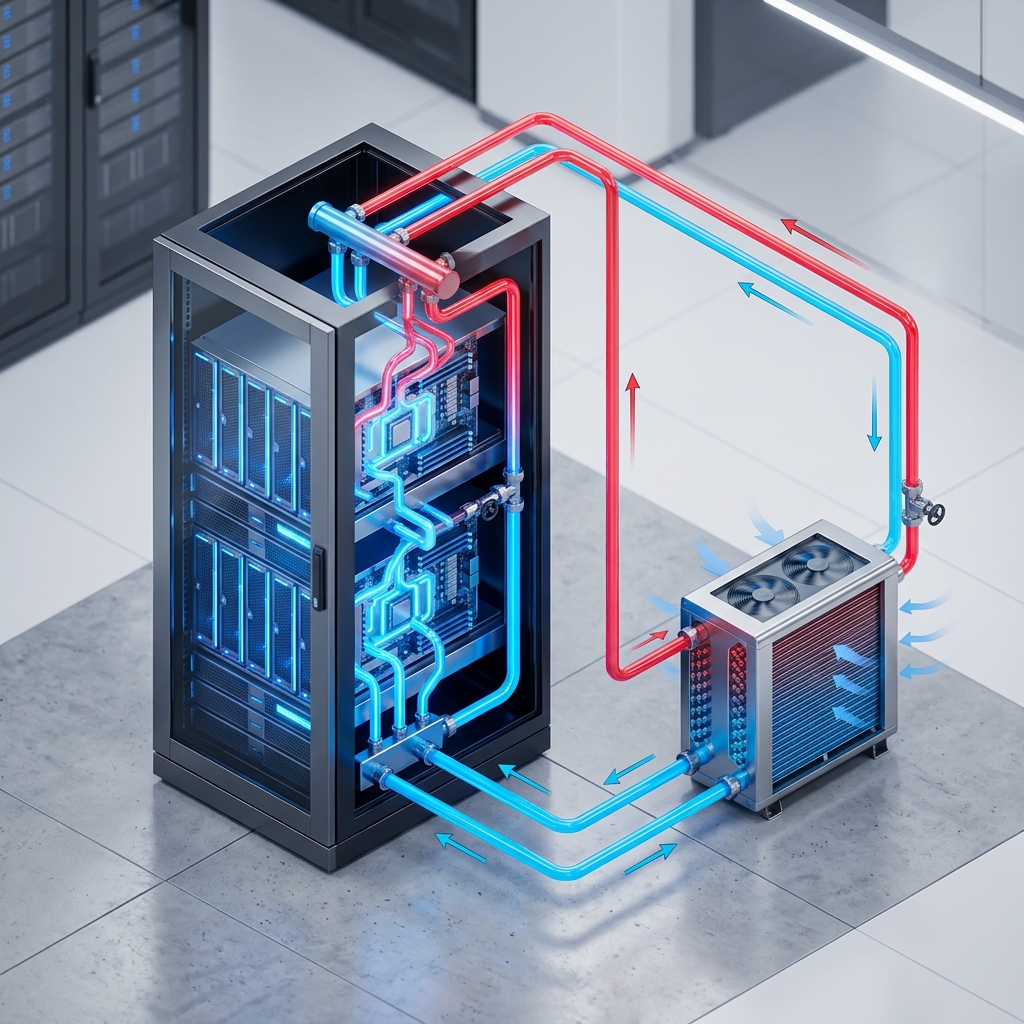
Heat is generated by servers
- Servers, GPUs, and networking gear produce intense heat.
- High-density AI and compute workloads heavily amplify this.
Coolant absorbs the heat
- A liquid coolant (water or water-glycol mix) flows through pipes or cold plates attached to servers.
- Absorbs heat directly at the source (much more efficient than air cooling).
Heat transferred via exchanger
- The heated liquid passes through a centralized heat exchanger.
- Heat is transferred to an external system, completely without mixing fluids.
Water is reused continuously
- The same water is recirculated over and over in a sealed loop.
- Very little water is lost: No evaporation, and minimal leakage if properly maintained.
Liquid Cooling Visualization
Where Water Is (and Isn't) Used
A direct comparison of modern versus older infrastructure strategies.
Closed-Loop System
- Water is contained and reused.
- Losses are minimal (maintenance-level only).
- No constant intake of fresh water.
Traditional (Evaporative)
- Water is consumed continuously.
- Large losses from evaporation.
- Requires constant replenishment.
Project Horizon's Chip-Level Liquid Cooling
A real-world example of modern closed-loop design in action is Poolside Infrastructure's Project Horizon, located in the West Texas desert. The facility utilizes liquid cooling taken directly to the chip. CEO Robert Bonar explains: “Because we are in these proprietary systems, we can reject that heat at a higher temperature, which means that we don't need to rely on water anymore for cooling. We'll use more water for toilets than we do for cooling the data centers.”
Read the Forbes Article